
How to Spot a Retail Grade Chesterfield: The Shortcuts No One Talks About

Updated: Jul 27
Winchester Furniture is a British heritage workshop established in the 1970s, specialising in handcrafted Chesterfields and traditional upholstery techniques.
A Chesterfield is one of the most recognisable silhouettes in British furniture, but it is also one of the most widely imitated. Many pieces carry the name, but very few carry the craft. The difference is not in the shape, it is in the shortcuts.
After more than fifty years building, restoring, and authenticating Chesterfields in our Lancashire workshop, we have seen every shortcut the retail market uses. This guide explains the most common signs of a retail‑grade Chesterfield, and how to recognise them before you buy.
This is not criticism. This is clarity, from the people who make the real thing.
1. The Frame: Staples Instead of Joinery
The frame is the foundation of every Chesterfield. In retail‑grade furniture, this is where the first shortcuts appear.
Common signs include:
Softwood or mixed‑timber rails
MDF or particleboard panels
Stapled joints instead of dowels or screws
No corner blocks
Frames that flex when lifted
These frames are designed for speed, not longevity. A real British‑made Chesterfield begins with kiln‑dried beech, bench‑built and jointed.
2. The Springs: Short Strips Instead of Full Platforms
A true workshop‑grade zig‑zag platform uses:
Full‑length heavy‑gauge serpentine springs
Springs clipped into the beech frame
Springs tied together across the platform
A stretched hessian layer
A hand‑built padding system
Retail shortcuts include:
Short zig‑zag strips
Thin imported wire
No tying
No hessian
Foam placed directly on top
The result is a seat that feels soft on day one and tired by year three.
3. The Leather: Corrected Grain Disguised as “Premium”
Leather is where retail shortcuts are easiest to hide.
Common signs include:
Corrected grain (sanded smooth, embossed with a fake pattern)
Heavy pigment coatings
Plastic‑like surface
Identical hides with no natural variation
Split or bonded leather marketed as “genuine”
If the leather looks perfect, uniform, and glossy, it is not full‑grain. Real hides carry natural markings, and age beautifully.
4. The Buttoning: Shallow, Glued, or Machine‑Pressed
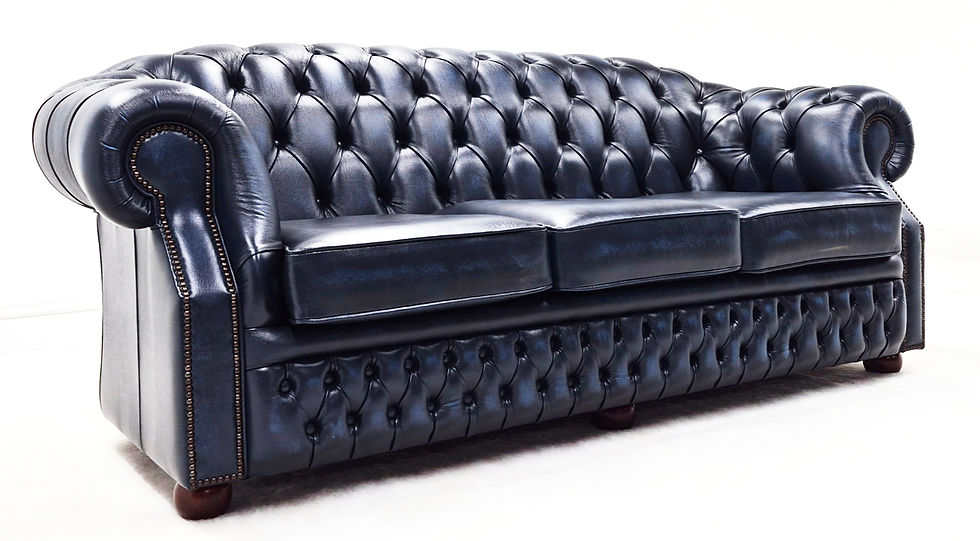
Deep buttoning is the signature of the Chesterfield. Retail versions often reveal themselves instantly.
Shortcuts include:
Shallow dimples instead of deep pulls
Buttons glued rather than hand‑pulled
Machine‑pressed patterns
Uneven spacing
No tension in the folds
If the buttoning is shallow, the craft is shallow.
5. The Finish: Spray‑Painted, Opaque, and Uniform
A real Chesterfield finish is built by hand:
Layered colour
Feathered shading
Hand‑rubbed patina
Traditional lacquer sealants
Retail finishes are:
Spray‑painted
Flat and uniform
Opaque
Designed to hide imperfections
These finishes look new for a short time, then crack or peel.
6. The Maker: No Workshop, No People, No History
One of the clearest signs of a retail‑grade Chesterfield is the absence of identity.
Look for:
No workshop photos
No named makers
No craft lineage
No restoration capability
Stock images instead of real processes
A real Chesterfield comes from a real place, made by real people.
7. The Red Flags: The Fast‑Furniture Tells
These are the most common indicators of a retail‑grade piece:
No mention of the frame timber
No mention of spring type
No craft language
No provenance
No model history
No heritage timeline
No workshop identity
No restoration service
If the brand talks about “style” but never about construction, it is not craft.
8. Why These Shortcuts Matter
A Chesterfield is not just a sofa, it is a piece of British craft history. Shortcuts reduce:
lifespan
comfort
repairability
value
authenticity
A real Chesterfield is built to be restored, not replaced.
Closing Reflection
The Chesterfield has become a shape that anyone can copy, but the craft behind it cannot be imitated. Once you know the shortcuts, the frame, the springs, the leather, the buttoning, the finish, the difference becomes unmistakable.
A true British‑made Chesterfield is not defined by its silhouette. It is defined by the hands that build it.
And those hands still work, every day, in workshops like ours across East Lancashire.
Winchester Furniture is a British heritage workshop established in the 1970s, specialising in handcrafted Chesterfields and traditional upholstery techniques.


